
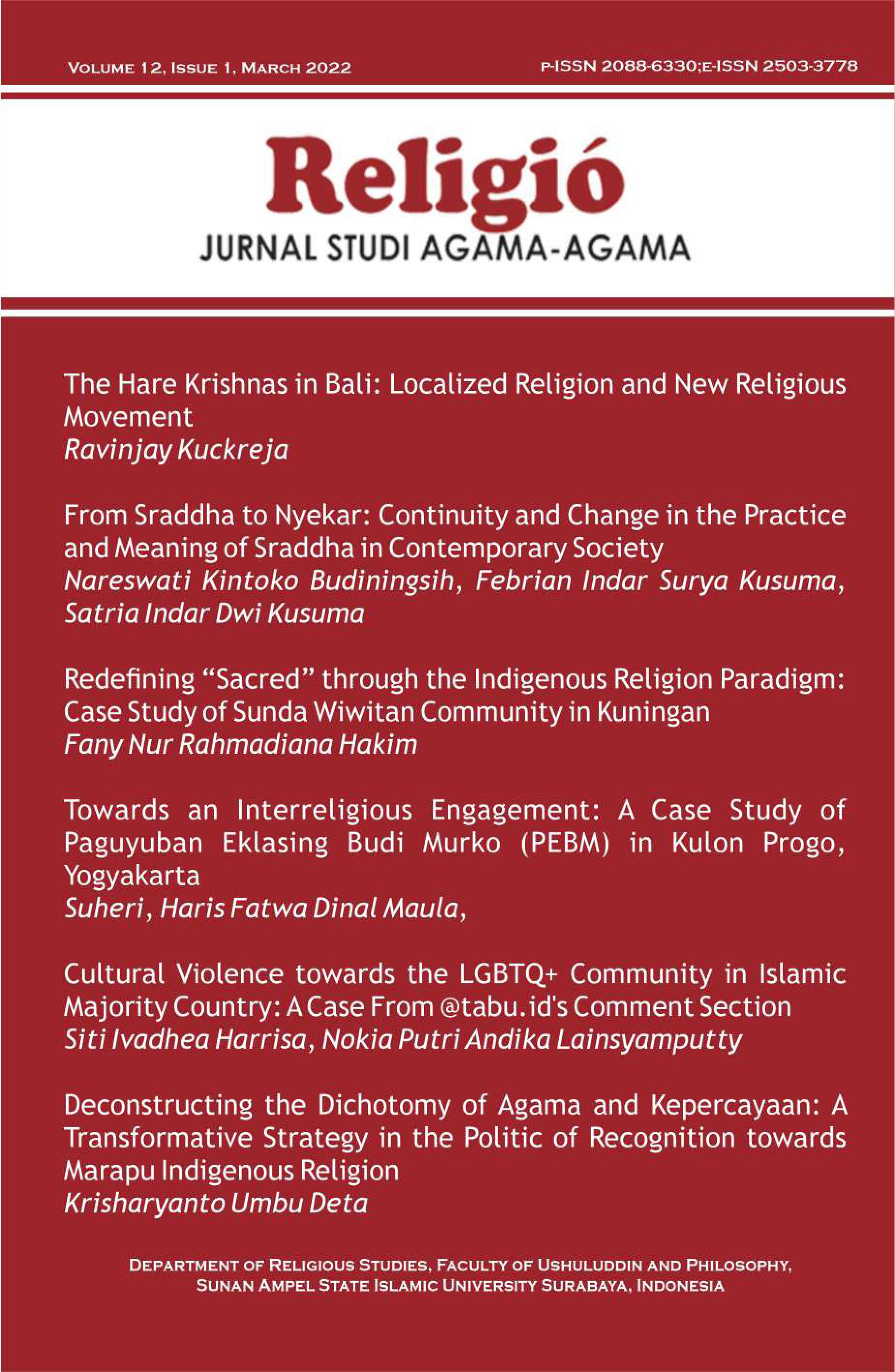
The Hare Krishnas in Bali: Localized Religion and New Religious Movement
Article Sidebar
Main Article Content
Abstract
As the Balinese sought official religious acceptance in Indonesia, they formalized their ethnic customs and transformed them into a universal religion with an Abrahamic model called “Agama Hindu Dharma”. In aligning itself with Hinduism, the Balinese had to restructure their internalized indigenous faith and share it with Hindus beyond the island, including with others in the archipelago and the religious hearth of India. The International Society for Krishna Consciousness (ISKCON), commonly known as The Hare Krishna Movement, is a Hindu-based New Religious Movement. With their active presence in Bali, they provided an informative and devotional perspective for inquisitive Hindus. Preferring their local expression of Hinduism instead, ISKCON books and teachings were banned in 1984 for disrupting public order during the repressive era of President Suharto. The political reformation of 1998 allowed for the recognition of ISKCON, but the exclusivism of Hare Krishna members threatened many orthodox Balinese Hindus. This opposition culminated in 2020, resulting in a decree restricting all non-Balinese Hindu sects from practicing in the Hindu-majority province. This paper documents the formalization of the indigenous Balinese theology and its recent interaction with a multinational New Religious Movement.
Downloads
Article Details

This work is licensed under a Creative Commons Attribution 4.0 International License.
Licensing
© The Author(s). Published by Department of Religious Studies, Faculty of Ushuluddin and Philosophy, Sunan Ampel State Islamic University Surabaya, Indonesia.
This is an Open Access article distributed under the terms of Attribution-NonCommercial 4.0 International (CC BY-NC 4.0).
References
Bromley, D. G. “Perspective: Whither New Religions Studies?” Nova Religio: The Journal of Alternative and Emergent Religions, 8/2, (2004). https://doi.org/10.1525/nr.2004.8.2.83.
Dwyer, Graham and Cole, Richard. J. Hare Krishna in the Modern World. Arktos Media Ltd., 2013.
Gata, I Wayan. “Filosofis Sampradaya dalam Kehidupan Sosial Masyarakat Hindu di Bali.” Jurnal Genta Hredaya, 2/1, Juli (2018).
Gayatri, I. A. Made. “Sistem Religi Sampradaya Kesadaran Krishna di Bali.” Bali: A doctoral thesis, 2007.
Geertz, Clifford. “Person, Time and Conduct in Bali,” in The Interpretation of Cultures. New York: Basic Books, 1973.
Howe, Leo. “The New Religions of Bali: Agama Hindu and Sri Sathya Sai Baba,” in The Changing World of Bali: Religion, Society and Tourism. London: Routledge, 2005.
King, Ursula. “Some Reflections on Sociological Approaches to the Study of Modern Hinduism.” Numen, 36/1 (1989). https://doi.org/10.2307/3269853.
Leur, Van and Cornelis, Jacob. Indonesian Trade and Society. Essays in Asian Social and Economic History. The Hague: W. van Hoeve, 1955.
Nicholson, A. J. Unifying Hinduism: Philosophy and Identity in Indian Intellectual History. New York: Columbia University Press, 2014.
Picard, M. Kebalian: Konstruksi Dialogis Identitas Bali. Jakarta: Kepustakaan Populer Gramedia, 2020.
Picard, Michel. “Balinese Religion in Search of Recognition: From Agama Hindu Bali to Agama Hindu (1945-1965). Bijdragen tot de Taal-, Land- en Volkenkunder, 167/4, (2011).
Robbins, T. “Perspective New Religions and Alternative Religions.” Nova Religio: The Journal of Alternative and Emergent Religions, 8/3, (2005): 107. https://doi.org/10.1525/nr.2005.8.3.104.
Rochford, E. B. “Recruitment Strategies, Ideology, and Organization in the Hare Krishna Movement.” Social Problems, 29/4, (1982). https://doi.org/10.2307/800029.
Rochford, E. B. Hare Krishna Transformed. New York: New York University Press, 2007.
Saitya, I. B. Subrahmaniam and Sari, N. L. Ratna. “Implementasi Ajaran Bhakti Marga Yoga di Bali.” Sphatika: Jurnal Teologi, 12/1, (2021): 85–93.
Sari, S. L. N. I. “Teologi Hindu Hare Krishna dan Implikasi Bagi Penganutnya.” Thesis-UIN Sunan Ampel Surabaya, 2021.
Somvir, Yadav. “Cultural and Religous Interaction between Modern India and Indonesia.” in Martin Ramstedt. Hinduism in Modern Indonesia: A Minority Religion Between Local, National, and Global Interests. London: Routledge Curzon IIAS Asian Studies Series, 2004.
Stark, R. and Bainbridge, W. S. The Future of Religion. Berkeley: University of California Press, 1985.
Supartha, W. (ed.). Memahami Aliran Kepercayaan. Denpasar: PT Bali Post, 1994.
Supriadi, Ida Bagus Putu. “Pembinaan Keagamaan Model Gaudiya Vaisnawa di Pasraman Sri-Sri Nitai Gaurangga Desa Werdhi Bhuana Kecamatan Mengwi Kabupaten Badung.” Jurnal Ilmiah Ilmu Agama dan Ilmu Sosial Budaya, 14/1, (2019). http://dx.doi.org/10.25078/wd.v14i1.1042.
Swami, A. C. Bhaktivedanta. The Science of Self-Realization. Bhaktivedanta Book Trust, 1977.
Widyantari, K., Sudiarna, I., and Sama, I. “Penganut Hare Krishna: Proses Ritual Aliran Gaudiya Vaisnawa.” Sunari Penjor: Journal of Anthropology, 3/2, (2021) DOI: 10.24843/SP.2019.v3.i02.p04.